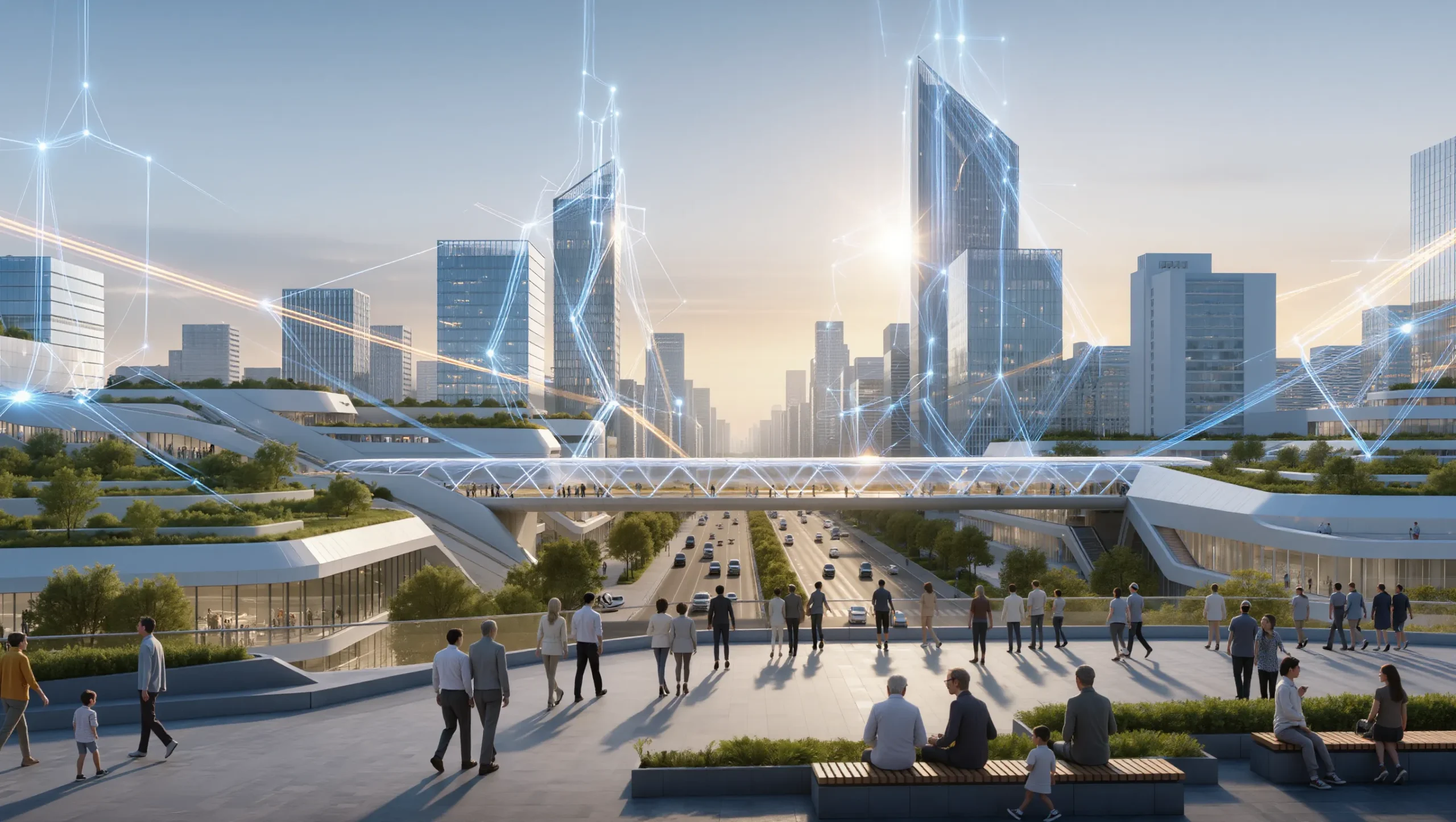
Integrating Non-Human Productivity into the Economic Contract of Modern Civilization
A Historic Economic Transition
The global economy is undergoing a transformation of historic magnitude, comparable only to the Industrial Revolution.
Automation, robotics, and artificial intelligence are no longer mere extensions of human labor; they have become autonomous sources of productivity, capable of generating massive financial flows without traditional human work.
This transformation was anticipated decades ago. In 1930, John Maynard Keynes warned of technological unemployment, defining it as a condition in which “we discover new uses for labor more slowly than we discover ways of saving labor.”
Today, this prediction is no longer theoretical — it is a systemic reality.
Unfair Competition Between Human Labor and Automated Productivity
Human labor remains burdened by taxes and social contributions.
By contrast, AI systems and robots — despite eliminating jobs — do not directly contribute to pensions, unemployment insurance, or social security.
This asymmetry creates a form of structural unfair competition, fundamentally incompatible with the principles of a just economy.
Thomas Piketty empirically demonstrated that, in the absence of corrective mechanisms, “the rate of return on capital tends to exceed the rate of economic growth, leading to extreme wealth concentration.”
Automation accelerates this very mechanism by channeling value toward technological capital.
From a moral and political perspective, Joseph Stiglitz warns that “excessive inequality is not just an economic problem — it is a threat to social stability and democracy.”
An economy in which AI creates value without contributing to the social contract is, by definition, structurally unstable.
Why Taxing Labor Becomes a Civilizational Error
Persisting in taxing labor within an automated economy represents, in the terms of Karl Polanyi, a “disembedding of the economy from society.”
Labor becomes a penalized commodity, while non-human productivity remains fiscally neutral.
This creates what Amartya Sen would describe as a loss of capability: individuals are deprived of real participation in economic life, not due to lack of effort, but because of flawed institutional design.
TTF SHIFT: Fiscal Integration of AI and Robotics Without Legal Fictions
TTF SHIFT resolves this problem not by artificially redefining AI as an “employee,” but through an elegant macroeconomic solution:
Tax financial flows, regardless of their source.
Through a uniform micro-tax on transactions:
- Financial flows generated by AI and robots become automatically taxable
- Automated capital contributes indirectly to pensions and social protection
- The state regains technological neutrality
This approach reflects precisely what Milton Friedman considered essential:
“An efficient tax system taxes real economic activity, not the moral labels attached to it.”
The Productivity Allocation & the €1,000 Top-Up: Legitimate Redistribution of AI Productivity
If TTF SHIFT collects the value generated by automation, the Productivity Allocation Card redistributes it in a form compatible with macroeconomic stability.
The €1,000 Productivity Allocation is not free money.
It is a direct economic right, derived from system-wide productivity generated by automation, artificial intelligence, and capital.
The automatic monthly top-up (up to €1,000):
Is not a salary
Is not a pension
Is not welfare
Is not a subsidy
It is a right derived from productivity, not from dependency.
This logic is explicitly supported by leading figures of the AI revolution.
Sam Altman states:
“If AI creates massive abundance, we must find ways to distribute that abundance broadly — otherwise the system will become unstable.”
Similarly, Elon Musk warns that
“AI will eliminate most jobs, and universal income or similar mechanisms will become inevitable.”
TTF SHIFT goes further: it does not create permanent budgetary dependence, but closes the fiscal loop through circulation.
Structurally Validated Advantages
a) Internalizing the Social Cost of Automation
Exactly as Arthur Pigou described in his theory of externalities:
those who benefit from automation contribute implicitly to the social costs it generates.
b) Saving Pension Systems
As Paul Krugman emphasizes:
“Social systems fail when their funding base no longer reflects the real structure of the economy.”
TTF SHIFT realigns that base.
c) Macroeconomic Stability
By increasing the velocity of money, not the money supply, the mechanism avoids inflation — a foundational principle of modern monetary theory.
The Philosophical and Civilizational Dimension
From a philosophical standpoint, John Rawls argued that institutions are just only if “the advantages of the most favored benefit the least advantaged.”
The Productivity Allocation applies this principle directly to an automated economy.
Scientifically, Stephen Hawking warned:
“AI may be the best or the worst thing ever to happen to humanity — it depends on how the value it creates is distributed.”
TTF SHIFT is an institutional answer to this dilemma.
Conclusion: From Technological Crisis to Economic Maturity
TTF SHIFT and the €1,000 Productivity Allocation Card transform automation from a threat into a stabilizing force.
AI produces value
The state taxes it at the level of financial flow
Society redistributes it as economic security
This is not a utopia.
It is the logical alignment of economy, technology, and justice — the very point of maturity anticipated by the great minds of economics and science, and now finally within reach of implementation.